Click Here for a PDF Version of this Article
C


SCBZSOTO9HCH20037, 1987
Bentley Turbo R SBH13247, 1972
Bentley
T-Series
Improvements to Window Lifts on
Rolls-Royce and Bentley Cars, 1972 to 1989
SY (Silver Shadow Series Cars) Chassis 13754 to SZ (Silver Spirit Series Cars) Chassis 27998
By: Richard Treacy, Switzerland. Last Updated March 31, 2006
I have implemented a thoroughly
worthwhile modification on my Turbo R, SCBZSOTO9HCH20037, which has
dramatically improved the performance of the window lifts from being mediocre
and unacceptable to outstanding. This is so successful that I am posting this
publicly.
Wow. Thundering windows alright !! This modification is a MUST. I have never
been so pleased with such an easy modification. It took about 15 minutes to
prepare each of five modules, and 20 minutes to fit each to the car.
The reason for all this is that, in order to save weight, R-R used very thin
wire on the window circuits, in my opinion only thick enough to power the
clock. From memory, R-R toyed with the idea of using a ring main on the
SZ cars, but backed off and simply continued to use thin wires as on the later
Silver Shadows. Being a car just prior to Chassis 13754, the windows on
our '72 T-Series are just superb, but the Turbo R's were just embarrassingly
slow. Many SY and SZ series cars are now suffering slow windows as the
wiring ages, and those cars benefit enormously from this modification.
Note that SY cars like ours, before chassis 13754, have a completely different electrical circuit design for the windows, and incorporate relays from new. That is the reason why the earlier SY cars suffer far less than the later cars. From SY chassis 13754, thinner wires were applied and the relays deleted. The window motors also switched from the earlier 4-wire dual field direction control motors to two-wire, permanent magnet motors. From then on, motor direction is controlled by reversing the armature polarity.
SZ cars from Chassis 30000 have an ECU and relays, but retain the two wire system.
So, the following only applies to the cars listed in the title.
Originally, both window motor supplies
are normally live. When the window switch is activated, one supply wire
is grounded to produce the voltage to lift or
lower the window. Given that the circuits are metres long and supplied by mere
microswitches, the voltage drop in the circuit is excessive, especially as the
cars age. Particularly, when the microswitch grounds its wire, the voltage at
the motor lead can be as high as five volts instead of zero. Time for a local
relay to remedy this. My driver's door was OK, but the other three left
somewhat to be desired of this fine beasty of a car.
To fix the three wanton doors, you will need to make up 5 modules, each made
from:
- Bosch 0 332 204 122 changeover relay (R-R UD22452) and preferably a socket to suit. (Pairs may be tandemed for the rear door by sliding their slots together
- 6 spade receptors to suit the above
- two pairs of spade plug and socket (standard automotive type)
- 25 cm black, 30 cm red: 2.5 sq.mm automotive power cable
- 60 cm automotive low power cable, white, 0.7 sq. mm
- cable ties
- 1 general purpose power diode, type 1N4001, 1N4004, 1N4007, EM513 or equivalent.
- one earthing lug (bolt it to the door frame together with the relay socket)
One issue addressed here using the
original R-R equipment Bosch type of relay, and many other brands too: you must
insert a diode before each relay coil. In the configuration I chose, it
is essential. In the other possible configuration, with the relay + coils
connected to the cigar lighter circuit, there is potential to reverse bias the
coil slightly on the de-energised relay when the power supply (cigar lighter)
is on load. This potential can easily be enough to blow the diode
suppressor inside if an external diode is not fitted. Incidentally, this extra
diode even simplifies installation , as all five modules are identical. By the
way, on the rear doors you will notice that I implemented the configuration
such that the motor is normally at zero volts, not sitting with both terminals
normally live as originally they were. I have an aversion to leaving electrical
devices permanently live. To do this job, I opened up a rear door to see the
arrangement, designed the simple layout, made two modules up in the
workshop, and then installed them.
Previously, I measured typically 4 volts across the rear door motor supply
leads when activated; now it's at least 11 volts and the windows are fast
as
lightning.
The slowest window is now the driver's !!! The solution on the passenger side works amazingly well, and the windows are now as fast as any new car. The rear doors each have a high current supply for the cigar lighters available, but the front ones do not, so a half solution improving the grounding on the passenger's door is the only easy one, but it gives a 100% result anyhow. My LH rear window was inoperative from the driver's door because of the poor conductivity, but now zips up and down like a new one. It had 4 volts across the motor terminals when operated locally, and 2 volts when operated from the driver's door. I used 2.5 sq.mm power automotive cable for the power side of the mod.
The front passenger's door uses one
module, the rear doors two each.
I reused the original motor plug connector unaltered, so the motor and its
supply plug and lead are strictly original in case of replacement. To the
existing socket fitted to the car, I fitted new spade receptors. To do this,
cut the existing motor supply wires at the socket and remove the old
receptors. Use a pair of identical spades and sockets to connect the
existing pair of wires to your new relay set, so that if the motor
direction ends up incorrect you may reverse them.
Along with the modification, it is
advisable to replace the 20A cigar lighter fuse with a 30A one, in line with
the original window fuse ratings. I raised all
four windows at once and the fuse did not blow.
I strongly recommend this mod to all SZ car owners ! Anyone who wants a
schematic and layout may
E-mail me so I can E-mail them as jpeg
files. You may also right click on any image to download it.
Note
that replacement window lift microswitches, where required, must be DC
rated. A suitable microswitch is the Omron V-21-1C6 , available at any
industrial electrical supplier. This switch is ideally rated 21A at
250VAC, and 18 A at 14VDC.

NOTE: On some cars (Silver Shadows for example), the wires to the window motors are yellow and yellow/black. On others they are blue and white. This does not change the configuration in any way.


A pair of sockets being pushed into tandem, and the components required for one module:


Relays
Just about any brand of relay will do as long as it is a 12V changeover type (double pole, single throw) as used extensively in every motor vehicle produced. Below is a picture of the Bosch type, and also an equivalent pin-for-pin compatible aftermarket brand. All relays with pinouts 30, 85, 86, 87 and 87a are electrically and functionally identical, but may have either a diode or conventional suppressor. With the configuration proposed above, it is irrelevant whether the relay contains a diode or a conventional suppressor.

85 = coil -
86 = coil +
30 = contact common
87 = normally open contact
87a = normally closed contact
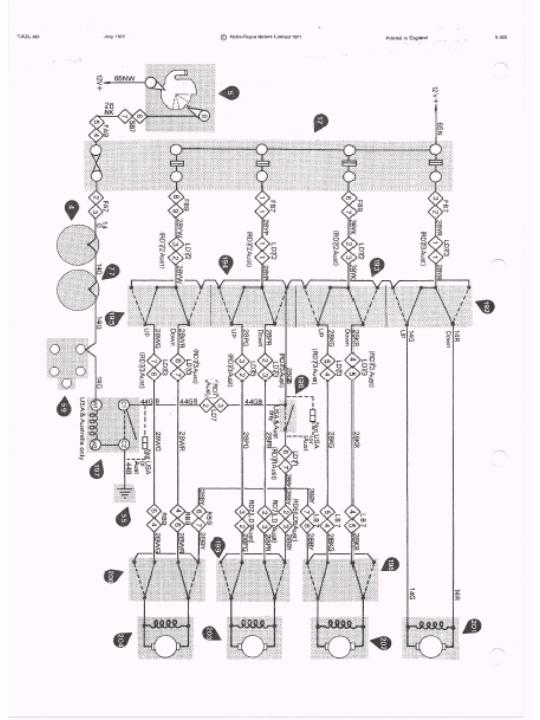
Schematic
for Earlier SY Cars Including the Original Relay

Schematic
for Later SY Cars from Chassis 13754, and SZ Prior to Chassis 30000. The
Relay Is for US and Australian Cars. Other Cars Have the Bridge (Shown
Dotted) Installed Instead.
Why the Diodes ?
I have been asked this question several times now, so here is a general reply:
The configuration that I have chosen is
no accident, and will only work with the diodes in place. On the front
passenger's door, it is impossible to delete the diode without running a new
wire through to the door innards. In that case, you would fit two relays
anyhow, as on both rear doors. In each case, the relay picks up when the
potential difference between the control wires is 12V and of the correct
polarity. The diode is the simple logic device to allow the relay to pick
up only when it should, and also to protect the relay suppressor as explained
below.
With a reconfiguration, it is marginally possible to delete the diodes on the
rear doors only, but it is unwise. Diodes only cost 10c or so anyhow.
Any general purpose power diode like a
1N4001, 1N4004, 1N4007 or EM513 is fine.
Let me explain.
Most Bosch relays, and other brands too, use a freewheel diode as a suppressor
(stops voltage spikes which cause radio noise and damage electronics). When
even the substantial cigar lighter power cable is used as a trunk feed as on
the rear doors, there is a certain voltage drop on load. This trunk wire would
need to be used as the reference voltage for both relays on the + coil terminal
in a reconfigured setup. This means that the relay not being activated would
have a reduced reference voltage while the window is working or the cigar
lighter is being used. As the other side of the coil would remain at +12V as
fed unloaded from the driver's door, the relay coil would have a slightly
reversed voltage. Anything above 0.6V reversed will burn the freewheel
diode inside the relay to bits as it starts to conduct. Given that you expect a
voltage drop of up to 2V, the Bosch relay would not survive. Even using a
cheaper bipolar relay with a conventional suppressor, it would be very bad
practice to allow this reversed voltage situation. In worst case, both
relays may try to pick up, and then give either no function or buzzing.
Now, you would not want the windows to shift or fail just because someone presses the cigar lighter would you ? Conceivably, other loads (headlamps, fans etc) could cause the same effect. Definitely, winding two windows at once would be risky without the simple insurance of the diodes.
It's best to fit the diodes, even if you decide on a different schematic.
Richard.
Beware ! Has your Silver
Shadow, Silver Shadow II or Derivative Had Its Final Drive Crossmember
Reinforced Yet ? Has a Plate Been Fitted to the Boot Floor ?
For the Important and Necessary Silver Shadow Final Drive Safety Modifications,
See:
http://rrtechnical.info/finaldrive/FinalDriveCrossmember.html

If the window lifts are slow, it doesn't matter to me on my Turbo R !
